

Emily Maguire's ‘Rapture’ wins NSW Literary Awards People's Choice
The winners of the 2026 NSW Literary Awards have been announced, including Emily Maguire’s Rapture (Allen & Unwin) taking home the People’s Choice Award.
The University of Sydney People’s Choice Award was voted for from the shortlists for the Kenneth Slessor Prize for Poetry, Christina Stead Prize for Fiction, and the Douglas Stewart Prize for Nonfiction.
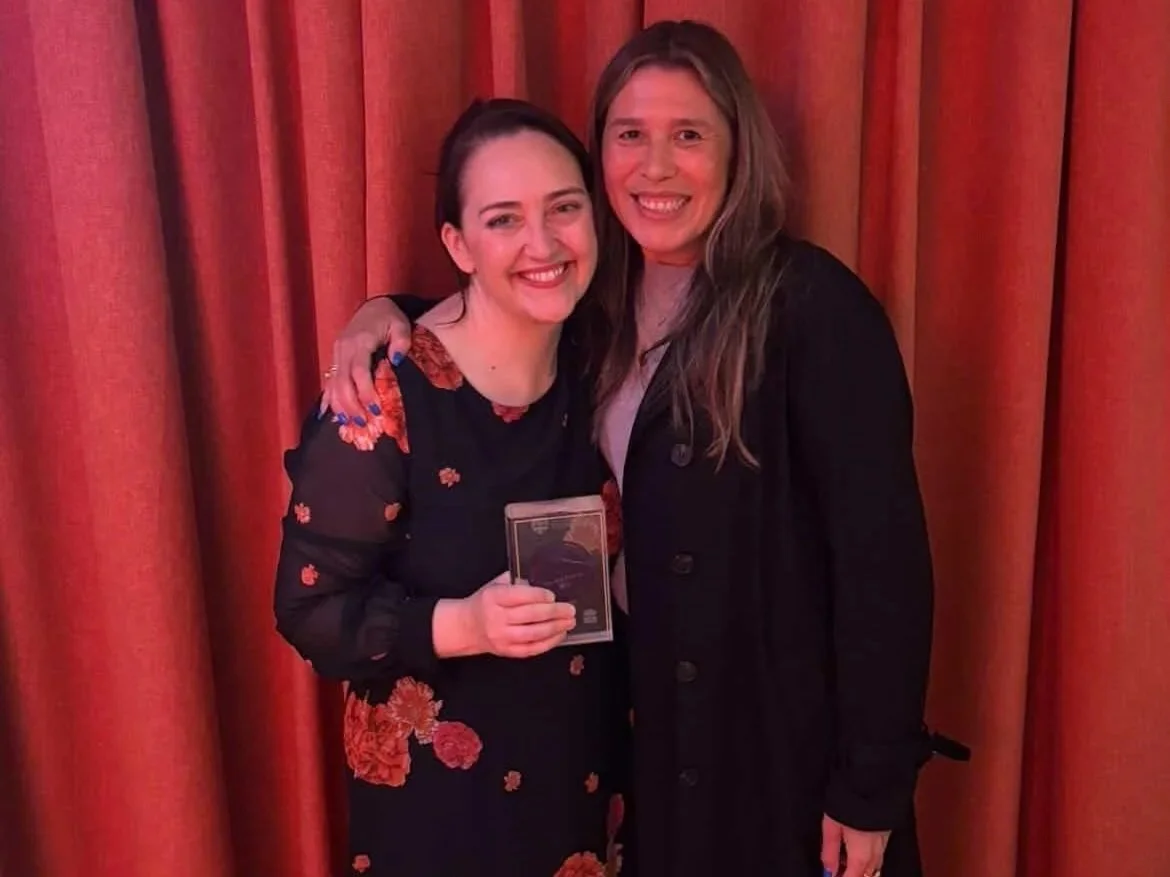
Emily Maguire (left) pictured with a4 Literary agent, Grace Heifetz (right)
The judges of the Prize for Fiction noted Rapture was: “An astutely paced and completely immersive historical novel, (that) follows its protagonist Agnes over almost 40 years of her life, from motherless child in Mainz to disguised monk in Fulda to Pope-ascendant in Rome. In her quest for agency and knowledge, Agnes is a superbly realised heroine for any era, interrogating issues of gender, faith, desire and the body across her (disguised) hero’s journey.
The judges were impressed by Emily Maguire’s ability to speak effortlessly to a contemporary audience using a setting more than a millennium old. Every metaphor feels pressure-tested and refined against the novel’s context. The prose itself is rapturous, the ending stunningly executed and one can only imagine the level of research required to carry off Agnes’s narrative this convincingly. Maguire has crafted a powerful voice in Agnes that will live with readers for a long time. This is a beautifully written reflection on love and belief.”
Speaking broadly about the 2026 awards, Senior Judge James Bradley OAM said, “The judges of this year’s awards were deeply impressed by the strength and variety of the work submitted. This year’s winners, chosen from 783 entries across twelve categories, are a thrilling testament to that breadth. Their works explore topics ranging from Indigenous history and the often-painful legacies of Australia’s past to migration and displacement, love, ageing and mortality.
Time and again, the winning authors demonstrate not just the power and vitality of Australian writing, but also the capacity of great literature to help us understand the past, and think differently about the future.”